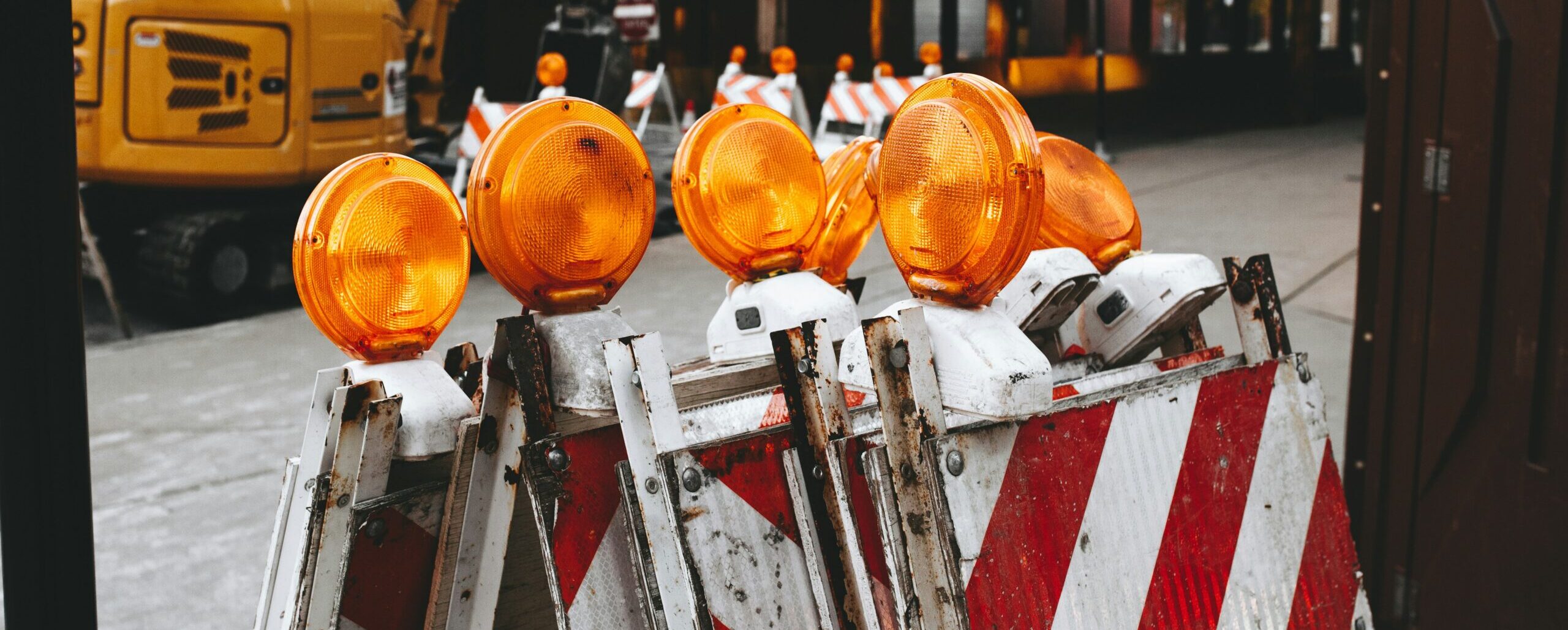
American construction has gotten less productive for half a century while the rest of the economy raced ahead. A large share of that gap traces back to how we approve buildings. There is a faster, more accountable way to do it.
There is a strange contradiction at the center of the American economy. The technological frontier is moving faster than ever, yet the physical act of building, whether a restaurant, a bank branch, or a warehouse, has become slower and more expensive. The gap between how quickly we can design and how slowly we can build keeps widening, and it carries a real cost in lost revenue, delayed openings, and unaffordable housing.
To understand why, it helps to start with a number that economists have called, in plain terms, strange and awful.
Construction productivity has gone backward for fifty years
Research from the University of Chicago’s Becker Friedman Institute, authored by economists Austan Goolsbee and Chad Syverson, found that value added per worker in the U.S. construction sector was roughly 40 percent lower in 2020 than it was in 1970. Over the same half-century, productivity for the broader economy nearly doubled. Construction is the rare major sector that has moved in the wrong direction, and it has done so consistently for decades.
The researchers tested whether this was simply a measurement problem, the kind of statistical artifact that can make a healthy industry look sick on paper. Using physical measures, such as the number of houses and the total square footage built per worker, they confirmed that the decline is real. They point to a deteriorating ability to turn raw materials into finished buildings, and to the curious fact that construction activity does not flow toward the regions where it would be most productive.
The stakes are not abstract. The authors estimate that if construction labor productivity had grown at a modest one percent per year over those five decades, aggregate U.S. labor productivity would be roughly 10 percent higher today. That is a substantial amount of national income left on the table, year after year.
“In no field is the phrase ‘time is money’ truer than in construction, where high interest loans and long lead times allow costs to pyramid quickly.”
Permitting is where time gets lost
Many factors contribute to slow construction, but one of the most uncontrollable is the approval process itself. In most of the country, plans are reviewed and permits issued by building officials employed by local governments. These officials are often not required to have a background in engineering or construction, and the government typically makes itself immune from lawsuits over their failures. When the process is slow and opaque, there is little recourse and little accountability.
As Joe Lonsdale and Judge Glock argue in their essay on the case for private permitting, the slowness is not just an inconvenience. It is frequently the very mechanism that invites arbitrariness, because a convoluted, months-long queue creates leverage. Their piece documents a striking number of recent bribery cases tied to building departments in cities across the country, each involving officials accused of taking payments to move permits along. The more complicated the process, the more room there is for that kind of behavior.
For developers and national brands, the practical experience is more mundane but no less costly: timelines that stretch well beyond the expected 60 to 120 days, unanswered calls, vague review comments, and expeditors who cannot break the logjam. Every week of delay is a week of lost revenue on a store that should already be open.
There is a proven alternative, and several states already use it
The fix is not to abolish standards. It is to change who does the work of checking against them. Under a private plan review model, also called third-party or private provider review, the government sets the rules and supervises the reviewers, while certified private firms perform the actual plan review and inspections. The government’s role moves one step back, from doing the work to defining the framework and holding providers accountable.
This is not a fringe idea. Florida has allowed private firms to handle inspections and permitting at a developer’s choice since 2002, and pairing that option with mandated public-sector timelines has driven a marked increase in timely approvals. Texas, Arizona, and New Hampshire allow private inspectors or permitters when local governments miss deadlines, and Texas even lets developers reach private inspectors immediately after a disaster to speed recovery. The same logic already governs other parts of public life, from product safety laboratories certified by federal regulators to airport security operations run by supervised private firms in much of Europe.
The accountability argument is the one most people get backward. Third-party review is often assumed to weaken oversight. In practice, it strengthens it. It is far easier for a government to pull a failing firm’s certification than to fire a failing employee, and separating who reviews plans from who sets the rules gives each side a clearer job. Governments can put their resources into auditing the reviewers and keeping the codebook current, rather than writing the rules and checking every plan against them at the same time. Most importantly, the model replaces a black box with a clear process. Developers know when something is wrong, who is responsible, and what to fix.
Why AI changes the math
Plan review is exactly the kind of work that modern technology is suited to accelerate. It involves applying a large, interconnected body of codes to a specific set of drawings, catching where one provision conflicts with another, and tracing how a citation in one section affects a requirement in another. A reviewer who can connect those references quickly, and surface issues before a plan ever reaches the city, can compress weeks of back-and-forth into a single clean submission.
This is the heart of what we call permit intelligence. At GreenLite, AI does not replace the licensed architects and engineers who carry regulatory authority. It makes their expert judgment faster and more consistent, connecting code provisions and jurisdiction research so that our reviewers catch problems early rather than discovering them after a municipal rejection. The result is a review that moves at the speed of business while remaining grounded in licensed professional accountability.
What this looks like in practice
The case for private, AI-native permitting is strongest when it stops being theoretical. GreenLite operates as a private reviewer across the country, whether or not the jurisdiction has a private plan review law on the books. In states with PPR statutes, our licensed architects and engineers serve as the certified third party who reviews plans on behalf of the city. In every other market, we perform the same review upfront, catching code issues and coordinating jurisdiction requirements before the plans ever reach a municipal reviewer. Across thousands of commercial projects, this approach has repeatedly turned timelines that traditionally run two to four months into a handful of business days, with clean first submissions and few or no revision cycles.
A few key figures:
- ~40% — Decline in construction value added per worker, 1970 to 2020 (Becker Friedman Institute)
- ~10% — Higher U.S. labor productivity today if construction had grown just 1% a year
- 7 business days — From submission to permit on a national pharmacy remodel, zero revisions
A few examples from GreenLite’s own project record:
- National automotive portfolio — 24 days: Average submission-to-approval across the account, roughly a 60% reduction from a timeline that had stretched past three months. Fewer than one revision cycle per project on average.
- National QSR chain, Florida — 20 days: An 81% reduction versus a projected four-month timeline, with zero revision cycles and no comments from the jurisdiction.
- National bank, Florida — 18 days: First-review approval with zero revisions. Pre-submission compliance checks caught more than 15 code issues before they reached the city.
- National pharmacy, Tennessee — 7 days: Permit issued seven business days after submission, approved on first submission with zero AHJ revisions in a market known for unpredictable timelines.
The bottom line
Construction does not have to be the one sector that keeps getting slower. The research tells us the productivity decline is real and expensive. The policy record tells us that states which open the door to private, accountable plan review get faster, more predictable approvals without sacrificing safety. And technology now makes it possible to do that review with a speed and consistency that traditional processes cannot match. The opportunity in front of the industry is not incremental. It is the chance to remove one of the largest, most stubborn bottlenecks in the way of building.
Frequently asked questions
Research from the University of Chicago’s Becker Friedman Institute found that value added per construction worker was roughly 40 percent lower in 2020 than in 1970, and confirmed the decline is real rather than a measurement artifact. Contributing factors include a deteriorating ability to convert materials into finished buildings and resources failing to flow to more productive regions. Regulatory friction, including slow permitting, compounds the problem because in construction, time directly drives cost.
Private plan review, also called third-party or private provider review, is a model in which a state authorizes certified private firms to review construction plans and issue or recommend permits in place of, or alongside, a municipal building department. The government sets the standards and supervises the providers, while certified, liable professionals perform the actual review. States including Florida, Texas, Arizona, and New Hampshire have versions of this framework.
It depends on the jurisdiction and project, but GreenLite has repeatedly compressed timelines that typically run two to four months into a matter of business days. Across a national automotive portfolio, GreenLite reduced average submission-to-approval time to 24 business days, roughly a 60 percent reduction. Individual projects have been approved in as few as 7 business days with zero revision cycles.
There is no evidence of a race to the bottom in jurisdictions that have used private review for decades. Private firms are typically required to use certified engineers and licensed professionals and are legally liable for their mistakes, unlike many government departments that are immune from such suits. AI is used to support expert human reviewers, not to replace licensed professionals.
Sources
- Austan Goolsbee and Chad Syverson, “The Strange and Awful Path of Productivity in the U.S. Construction Sector,” Becker Friedman Institute, University of Chicago. Research summary available at bfi.uchicago.edu.
- Joe Lonsdale and Judge Glock, “The Case for Private Permitting,” 2026. Available at blog.joelonsdale.com.
- Hayden Dublois, “Fast Track to Success: How Florida Has Streamlined Its Permitting Processes,” Foundation for Government Accountability, 2022. Available at thefga.org.
- GreenLite project records, 2024 to 2025. Client and brand names withheld per GreenLite confidentiality practice.